Nearly 80% of people will experience low back pain in their lifetime, yet almost every product on the market treats the pain after it arrives. Keeper asks whether design can prevent it. It is an office chair for 20–35 year olds with sedentary jobs, developed from a concept that keeps the back muscles active through the working day.
The project started close to home. My father developed a back problem as he aged, and not long after, I watched a friend my own age go through an episode of severe back pain and felt helpless. As more people around me described similar episodes, it became clear the problem was not limited to older adults. With a family background in medicine, I wanted to see whether design could help, and kept the brief open instead of committing early to one kind of product.
Low back pain in numbers
- 650 Mil
- People affected: 1 in 5 of the global population
- No. 1
- Cause of disability worldwide
- 6-8 Weeks
- 60% of people recover within this time
- 12 Months
- 1 in 3 will have it again within a year
01 · Discover
Understanding Pain
Pain is personal: it cannot be seen, so it has to be assessed. Clinicians use the SOAP method (Subjective, Objective, Assessment, Plan), and the subjective part is commonly broken down into four questions:
Frequency
Intractable, chronic, acute recurrent, sub-acute or acute.
Restriction
Whether pain interferes with daily activities, with social life, or with the ability to work.
Intensity
Measured on a 1–10 scale, with emoticon (visual analogue) scales, category scales or a pain diary.
Emotion
How people cope, from Passive (no management) and Dabbler (tries self-care) to Integrator (regular self-care) and Self-manager.
Low back pain (LBP) is pain in the muscles, nerves and bones of the back, between the lower edge of the ribs and the lower fold of the buttocks. It ranges from a dull, constant ache to a sudden sharp pain, and is classed by duration as acute (under 6 weeks), sub-chronic (6–12 weeks) or chronic (over 12 weeks). It is hard to pin on a single cause; the common ones are improper posture, trauma, muscle weakness and disc degeneration.
Because my users sit for most of the day, I looked at whether sitting itself matters. A review on PubMed found no significant link between sedentary behaviour and LBP in children and adolescents, but a significant one in adults: sitting was associated with chronic LBP among call-centre employees, truck drivers, healthcare workers and office workers, and the number of daily working hours mattered too. Evidence on physical activity was more mixed, though for workers, who combine awkward postures with sedentary routines, staying active appears protective.
I also attended the IASP Global Year 2021 conference on back pain, which covered both the anatomy of spinal deterioration and the psychology of how patients see and correct themselves. It is where I fixed the target age group at 20–35.
Secondary research
- What is pain, and its assessment and characteristics / Coursera
- Association between sedentary behaviour and low back pain / PubMed
- The association between physical activity and neck and low back pain / PubMed
- IASP Global Year 2021 Conference
- Human back anatomy
- LBP treatments: Activator Method Technique
- Webinar on back pain
01 · Discover
Market Research
Existing products serve niche users: aids that physicians use with patients, beds, pillows, mats and back stretchers. The closest to my goal were posture correctors, but they are built for people who already have back pain, and experts caution that wearing a brace for long periods can weaken the very muscles it supports.
Hempvana Arrow Posture Corrector
A hemp-fibre brace with triple straps that gently pulls the shoulders back. Light and fully adjustable, but can fit short on long torsos.
Upright GO 2
A small sensor worn on the upper back that vibrates when you slouch and reports progress in an app. Discreet with a 36-hour battery, but pricier.
Berlin & Daughter Posture Corrector
A breathable stretch brace with padded straps, worn under clothing in six sizes. Not adjustable, and may stretch over time.
FlexGuard Posture Corrector
A pulley-adjustable brace with a built-in lumbar pad, effective for long hours of sitting. The buckles on the back can irritate.
The gap: nothing helps healthy people keep their backs strong before the pain starts.
02 · Define
Problem Statement & Design Brief
To make a mass-manufacturable product for users aged 20–35 with a sedentary lifestyle, so that they can prevent recurring and resulting lower back pain.
The product should be:
- able to help strengthen the back.
- usable in daily life.
- mass-manufacturable and suited to an office environment.
- appealing to target users aged 20–35.
- understood by users without needing instructions on how to use it.
- comfortable. It doesn’t necessarily have to be ergonomic, but it should be comfortable.
03 · Develop
Ideation
With no fixed idea of what the product would be (a chair? a pillow?), I started from what it should do and where. Since longer working hours were linked to LBP, I placed it in the office and listed what desk workers use every day: computers, desks, chairs, pens, bottles, lights. Brainstorming with colleagues produced wearables such as vests, rings, earphones, watches and bracelets that would vibrate to warn the user about a bad posture. When daily usefulness came up, my guide suggested building the idea into furniture people already use, like the chair or the desk.
One keyword shaped many of the sketches: uncomfortable. If a wrong posture felt slightly uncomfortable, the user would correct it without having to think about it.
With my guide, I then clustered the ideas by their underlying principle and picked a champion idea, the most feasible one, from each cluster, with the rest of the cluster feeding into it.
Stability
Products that keep the body straight and in a correct posture.
Sensing
Products that sense an incorrect posture and remind the user.
Strengthening
Products that keep the back muscles active for a longer back life.
03 · Develop
Three Concepts
Concept 1
Stability
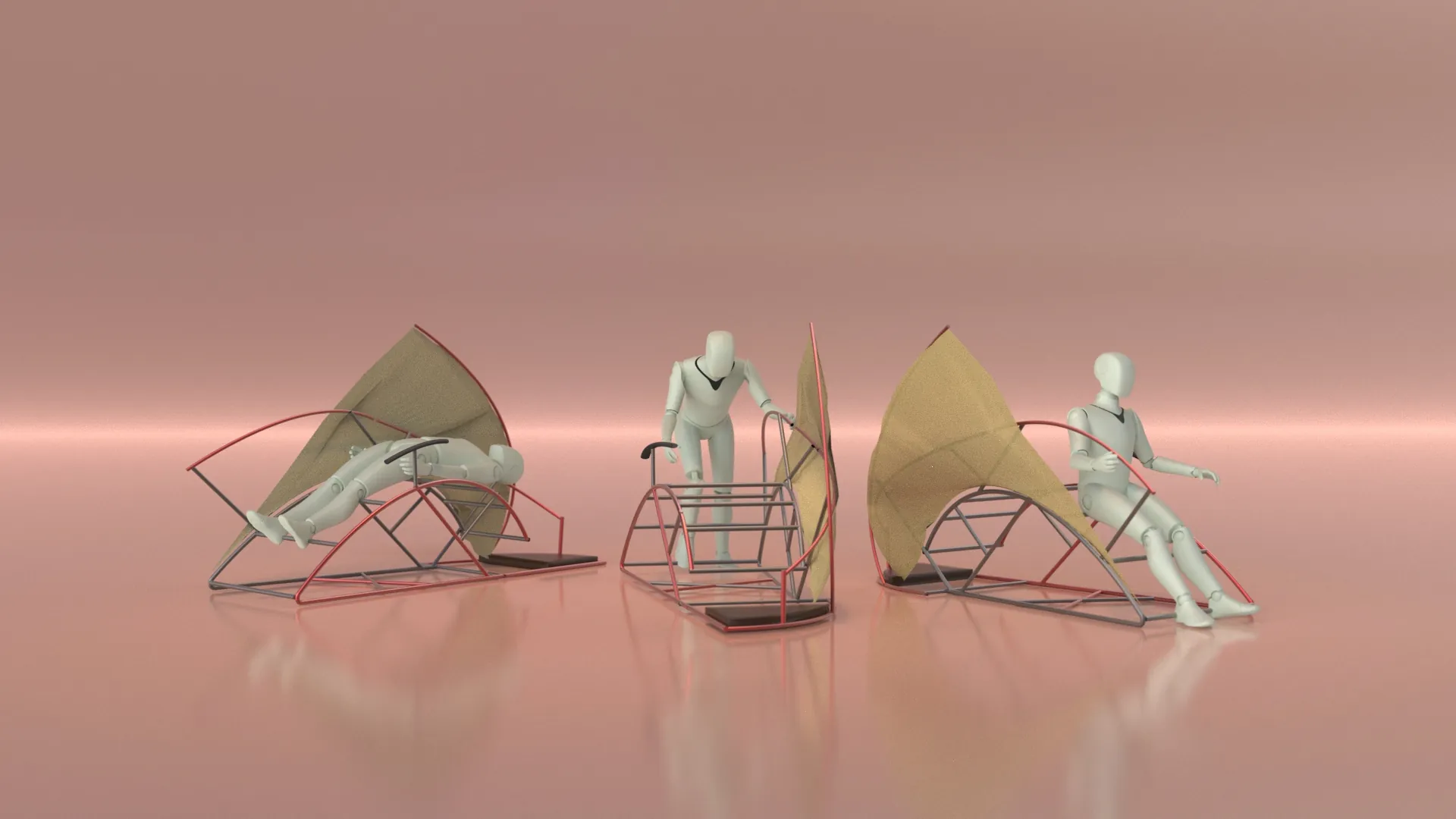
A seat inspired by amusement-park ride restraints. The back slides into a shaped shell that keeps it straight, and an adjustable, rotating handle keeps the user upright. Memory foam over hard foam, easy to make and to understand, but not portable.
Concept 2
Sensing
A wearable worn as an inner layer, with three sensing pads on the parts of the back where posture most often slips.
Concept 3
Strengthening
It started as a fun idea: a fidget element in the backrest that keeps the back muscles active. Suited to mass manufacturing, and deflatable for a more relaxed sit.
I made quick mockups of all three and asked users whether they would use them, why, and what would make them better. Concept 1 felt intrusive on personal space, Concept 2 got a lukewarm response, and Concept 3 caught people's interest, with several asking when they could try a prototype.
03 · Develop
Concept Evaluation
Each concept was scored out of 5 on the eight dimensions of quality (performance, features, reliability, conformance, durability, serviceability, aesthetics and perceived quality) plus ease of manufacture. Concept 3 scored highest, 37 against 31 and 24, and users aged 20–35 found it playful, so it went forward as Keeper.
04 · Deliver
Final Concept
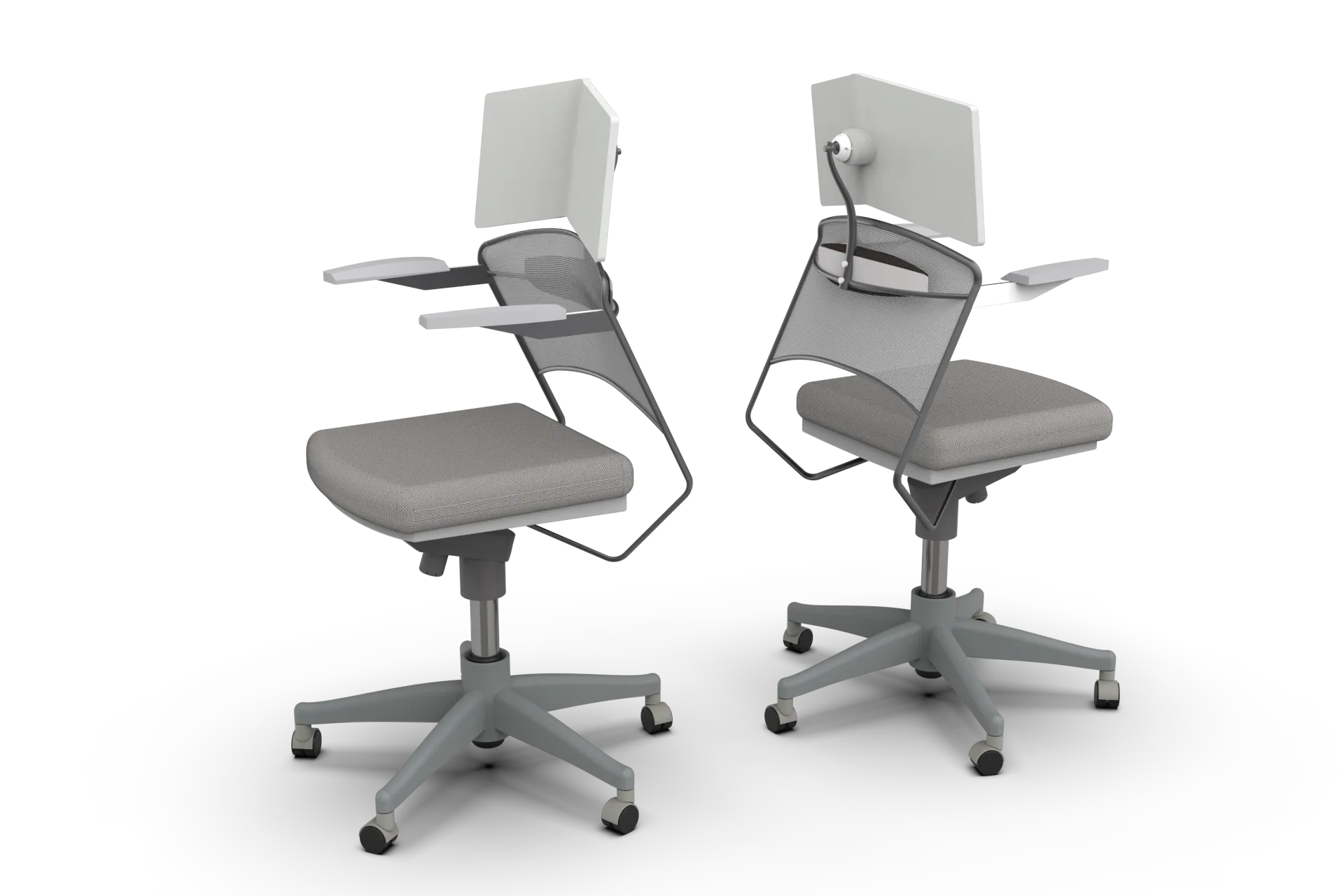
Keeper carries the strengthening concept into a full office chair. The backrest is mounted on a ball joint with a ratchet-tooth rack mechanism, and clips lock its movement when needed. The rest of the chair is made for the office: a mesh back, adjustable armrests and a brushed-steel frame, with dimensions set using anthropometry.
See how the mechanism works drive.google.com
Ratchet-tooth rack mechanism
Brushed steel, with clips to lock the movement
Mesh back
Adjustable armrest
04 · Deliver
Next Steps
Through this project I wanted to learn something new and have a tangible impact on how people live and feel. To take Keeper further, I plan to:
- Build a 1:1 prototype
- Decide on final dimensions and materials
- Test it with users
- Look into the manufacturing of the product
Guided by Prof. B. K. Chakravarthy, with feedback from Prof. Avinash Shende on the panel.