



Pregnancy is one of the most vulnerable periods in a person’s life, yet millions of first-time mothers navigate it without reliable information or consistent support. Most maternal deaths and complications are preventable, and beyond physical health, first-time mothers deal with anxiety, low health literacy, mood shifts and isolation. Periodic clinic visits, scans and paperwork don’t come close to meeting those needs.
How might we design a digital health companion that helps first-time pregnant mothers in India navigate clinical complexity, medication compliance and emotional isolation, with timely, trustworthy and culturally relevant support, without overburdening an already strained healthcare system?
01 · Research
What the Research Said
We reviewed 18 papers across conversational AI in healthcare, maternal mHealth, health literacy, wearables, prenatal education and online peer support, from small feasibility studies to cohorts of over 3,000 women, and from urban Indian slums to the German healthcare system.
Digital tools work when they are designed well
- 91%
- Satisfaction with mMitra voice messages among 2,016 low-income women in Mumbai
- 20–30%
- More postpartum visits with GPT-based chatbots, and 2–4× the return rate of text reminders
- 76%
- Of Indian first-time mothers open to a chatbot for breastfeeding guidance
- 18
- Papers reviewed, in three buckets: monitoring, mHealth apps, and care models
What we took from it
- Acceptance and technology aren’t the barrier; design quality and cultural relevance decide success
- First-time mothers have the biggest knowledge gaps and the most anxiety, so they gain the most from support
- Trust beats sophistication: Baby Buddy worked because midwives appeared in its videos, mMitra because it spoke Hindi and Marathi, while many GPT chatbots write at a college reading level
- Wearables, app design and maternity-care research sit in separate silos; no study combines monitoring, good design and accessible support in one platform
A second pass through week-by-week pregnancy guides and an existing pregnancy app showed two more gaps: most products are built around the foetus rather than the mother, and they present information densely. That pushed us towards a mother-centric app with a calm, minimal interface.
01 · Research
Talking to Mothers
Papers gave us the clinical picture but not the lived one. We interviewed six recent mothers about their first pregnancies (and what changed in later ones), ran a short survey with a trust matrix and a confidence matrix, and interviewed a doctor about what goes wrong between visits. The questions covered six areas: daily physical and emotional reality, where information comes from and who is trusted, the support ecosystem, mental health and taboos, technology use, and access to antenatal care.
- 6
- In-depth interviews with recent mothers
- 1
- Doctor interview
- 3
- Survey responses (mothers and family)
- 4
- Personas built from the interviews
02 · Insights
Problems Worth Solving
The strongest part of this project is what the research surfaced. Each problem became a requirement and then a feature:
The clinical jargon gap
→ Report summaries in her language
Mothers can’t read their scan and blood reports, and late-night Googling turns into anxiety spirals. Some already use ChatGPT or Gemini just to translate sonography reports their doctor had no time to explain.
Doctors sit at the top of the trust hierarchy
→ AI frames, the doctor decides
Every participant cross-checked apps and online information with their doctor before acting. AI is trusted to translate, not to decide, so Maaya turns findings into questions to ask the doctor rather than advice.
Missed medicine is a social problem
→ Nudges to the support person
Reminders are generic and the people around her don’t know what’s due. Nausea makes a mother skip iron for days, and nobody notices. Nudges explain the impact on the baby and quietly ask her husband to help.
High-risk mothers are invisible
→ Personal thresholds and auto-SOS
Apps track foetal milestones; mothers with IVF twins or high BP tracked vitals by hand because no app accounted for their condition. Vitals are now checked against her own safe range, with an automatic alert.
Isolation amplifies risk
→ A postpartum mode
Being alone led to negative thoughts; mothers coped with spiritual audio like Garbh Sanskar. After delivery, attention moves to the baby. A postpartum check-in asks about her, and shares a summary with her partner.
Language changes trust
→ Native-language voice
One mother trusted her care more once it came in her own language; another could translate English but lost the medical nuance. Summaries and notifications are spoken in the language she chooses.
03 · Define
Personas and Use Cases
The anxious first-timer
No prior knowledge, daily morning sickness, overthinking when alone. Needs constant reassurance and a second opinion on every symptom.
The high-risk mother
Gestational diabetes, bed rest or premature delivery. Can’t decode reports and needs condition-specific tracking with real-time alerts.
The traditionalist homemaker
Balancing a household with her own health; struggles with English-heavy content. Needs jargon-free regional-language content that fits a busy day.
The informed professional
Sits 8–9 hours a day and trusts doctors over family and AI. Needs science-backed explanations that adapt traditional advice to modern life.
Six use cases covered every major flow
- Understanding a jargon-filled scan report that arrives on WhatsApp at 11 PM
- A medication and scan nudge, shared with her husband through the Maaya support network
- Automatic SOS when a logged BP reading crosses her safe limit: pre-eclampsia caught at 34 weeks, not 38
- Booking the lowest-wait slot and arriving with a priority walk-in pass
- Sharing her whole history with a new doctor through a 24-hour QR link
- A 3 AM postpartum check-in that asks about her, not the baby
Storyboard: the late-night scan report
Storyboard: postpartum check-in
04 · Design
Information Architecture and Task Flows
Maaya has two users. The mother drives six sections from a central dashboard (onboarding, awareness, compliance, appointments, medical records and health tracking). Her support person receives alerts, sees her status and steps in when something escalates.
Each use case became a task flow with its trigger, the AI steps, the decision points and the edge cases (a failed upload, low AI confidence, a disconnected BP cuff, no free slots).
UC1: deciphering a clinical report at night
UC2: medication and scan nudge
UC3: vitals cross the threshold
UC4: low-wait booking and priority walk-in
We chose a hub-and-spoke layout and drew low-fidelity frames, using Gestalt principles, before moving to colour.
Low-fidelity frame: Home
Low-fidelity frame: Appointment booking and preparation
Low-fidelity frame: Record sharing and postpartum awareness
05 · Prototype
The Prototype
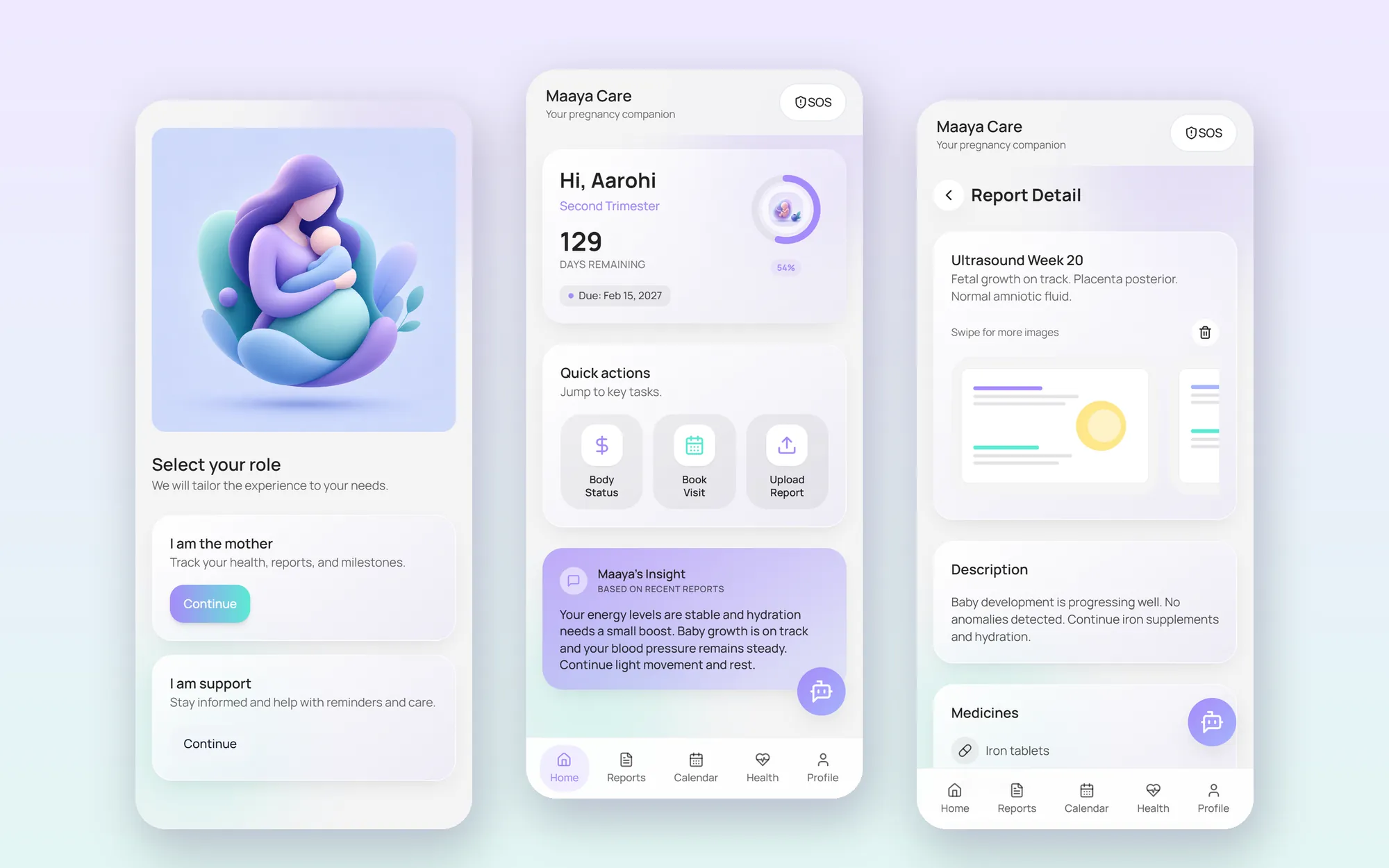
I built the final prototype as a clickable mobile app. The mother and the support person each get their own onboarding, and the home screen leads with the days remaining, quick actions and an insight drawn from her recent reports.
Welcome
Choosing a role
Onboarding
Home
Reports are the heart of the app: upload a photo or file, get an AI summary, and see each report’s findings, description and medicines in plain language.
Reports and AI summary
Report detail
Previous reports, with status
Health and vitals
Body status
Calendar
Booking an appointment
Maaya, the assistant, is one tap away on every screen, and SOS sits in the header: call emergency, notify the support person, or see emergency instructions.
Maaya chat
SOS
Support person sign-up
Profile and partner sharing
05 · Prototype
What Comes Next
This project stops at research and a prototype; we haven’t tested it with mothers yet. If I took it further, validation would come before any new feature:
- Usability tests with first-time mothers on the report-summary and nudge flows, measuring task success and whether the summary is understood correctly
- Testing the support-person nudges with couples, to find where helpful becomes intrusive
- A clinical review of the AI summaries and the BP and glucose thresholds before any alert reaches a real family
- Talking to clinics about whether a priority walk-in pass is something they would actually honour