What would Iron Man do without his helmet? What would Batman do without his mask? Apart from hiding their identity and enhancing their senses, the head is the most recognisable part of a superhero, after their abilities.
The brief asked for a superhero helmet. We treated it as a question about people instead: an average human is limited by their senses, so what if we could enhance their ability to see, hear or speak? How could an ordinary person get superhero-like senses, and would that change the way they perceive the world, and the world around them, for the better?
This project was an exploration first. The goal was to learn by building, across electronics, mechanisms and form, and to find out what actually works on a human head.
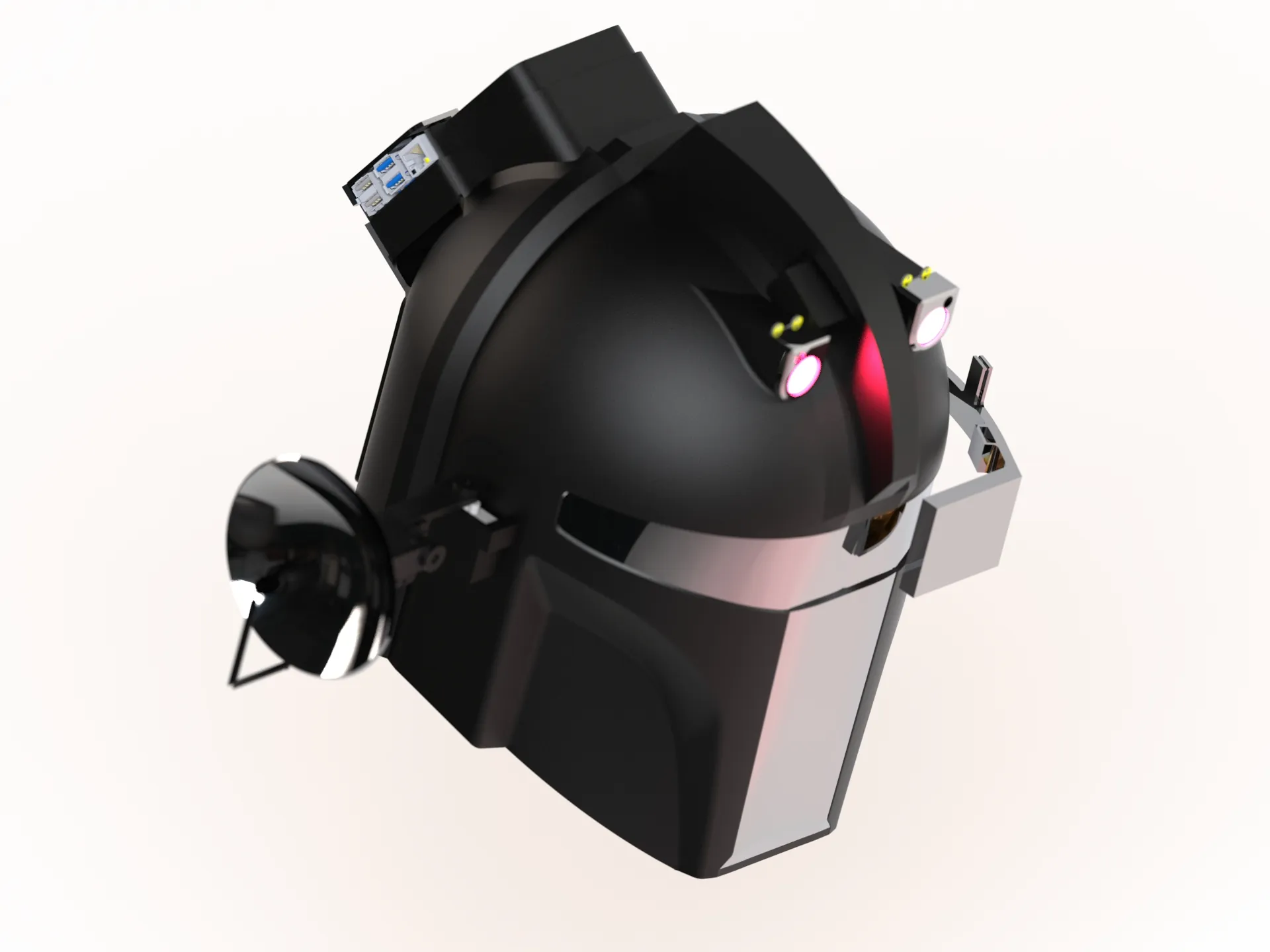
The prototype with its infrared lights on
The visor in action
01 · Ideation
Needs & Wishlist
When you think of a superhero, three things come to mind: enhanced senses, cool abilities, and a costume with a strong presence. We turned that into what someone in need of better abilities would want:
- To see and assess in the dark, for a real advantage.
- To hear distant sounds, like a cry for help.
- To mask their identity.
- To detect, assess and learn about objects around them.
- A cool factor and a dominant stature.
- To control all of these abilities on a whim.
Our vision (pun intended) was to fit as many senses as possible onto the head. The ideal feature list:
Infrared vision
Being able to see in the dark.
Heads-up display
Visualising information in front of the eyes.
Voice modulation
To mask the wearer’s identity.
Heightened hearing
Eavesdropping from a distance.
Generative shell
A lightweight structure, because who likes a heavy head?
Auto heating & cooling
Keeping the electronics, and the wearer, comfortable.
Mechanically wearable
Easy to put on, take off and actually wear.
02 · Preparation
Preparation
We modelled the shell and the visor mechanism in Fusion 360 and Rhino, sized parts in the slicer for 3D printing, and started testing electronics on the bench: microcontroller boards, a camera module and a small display.
Architecture
A Raspberry Pi 4 inside the helmet runs three servos, a microphone, an infrared camera and earphones. A Funduino controller and the battery sit outside it.
Tools
CAD in Fusion 360 and Rhino 3D, renders in KeyShot. Software in embedded C++ and Python, with ESP32 firmware, systemd services and PipeWire for audio.
03 · Prototyping
Where We Changed Course
Seven features was the dream. Building them showed us where the electronics, the mechanisms and the time would run out, and we made three decisions:
- Dropped precision on the directional microphone, to focus on night vision and the heads-up display.
- Settled the technical architecture and design around the limits of the electronics.
- Worked out the mechanisms and the scale of the product to match.
Failed mechanisms and burned electronics steered us toward more realistic approaches.
03 · Prototyping
Prototyping
We printed the helmet in parts, tried several mechanisms for opening the visor, and brought the electronics into the shell early so problems surfaced while there was still time to fix them.
Electronics mounted on the shell
The Funduino controller for switching abilities
First fitting
The display running object detection
04 · Final Product
Final Product
Heads-up display
The wearer switches between two modes, object detection and infrared night vision, both running on a Raspberry Pi.
Cooling
An integrated thermal copper heatsink and fan on the neck.
Retractable visor
For the cool factor of a futuristic design, and to make the helmet easy to put on and take off.
The final demo:
- Lights off, to test night mode (with the professor as a volunteer).
- A demonstration of the directional microphone.
- Visor actuation.
- Funduino controller integration.
04 · Final Product
What Exploring Taught Us
Rapid iteration
We quickly tested multiple mechanisms for opening the visor instead of perfecting one on paper.
Integration testing
Combining mechanics and electronics early exposed the real constraints of fitting everything on a head.
Failure-based learning
Failed mechanisms and burned electronics told us where to scale back, and made the final helmet possible.
Team Headless Monkey: Abhinav Borah (software integration and ideation), Kaushal Negi (CAD modelling and ideation) and Eshwar Pingili (electronics, ideation and modelling). Our biggest learning was a reality check, and a lot about both electronics and mechanisms.