



Parkinson’s disease (PD) makes eating hard. Tremors shake food off the spoon, swallowing becomes difficult, and the risk of malnutrition, weight loss and dehydration rises. This project set out to design eating solutions that help people with PD eat more independently, built on a literature review, a study of existing products, and time spent with neurologists, patients and their caregivers.
I chose the topic for three reasons: an interest in biomedical devices, a real problem that affects around 1% of people over 60 (a number set to grow as populations age), and a user group I had never designed for. Designing for older adults meant first understanding reduced dexterity, cognitive decline and limited mobility.
01 · Discover
Understanding Parkinson’s
PD is a progressive neurological disorder caused by the death of brain cells that produce dopamine, a chemical that helps regulate movement. Symptoms start mild and worsen over time: tremors, stiffness, slow movement, and poor balance and coordination, often alongside changes in speech and handwriting, depression, anxiety and cognitive decline. There is no cure. Medication such as levodopa, dopamine agonists and MAO-B inhibitors raises dopamine levels; deep brain stimulation or lesion surgery is used when medication stops working; and exercise, diet, physiotherapy and support groups help people keep leading full lives.
Parkinson’s disease progresses through four stages:
- Stage 1 (Mild) - Symptoms are mild and often go unnoticed: slight tremors, or small changes in posture, balance and gait.
- Stage 2 (Moderate) - Symptoms begin to affect daily activities: tremors, stiffness and changes in facial expression.
- Stage 3 (Significant Impairment) - Daily activities become difficult. Tremors worsen and balance is affected, making walking hard.
- Stage 4 (Severe) - The patient needs help with daily activities and may find it difficult to stand or walk.
Not every patient progresses through these stages in the same way, and treatment can slow the progression of symptoms.
This project focuses on patients in stages 2 and 3 of PD.
Eating is where many of these symptoms meet. Difficulty swallowing leads to malnutrition and dehydration, loss of manual dexterity makes handling cutlery and preparing meals harder, and medication such as levodopa brings side effects of its own.
Clinicians track PD with the Unified Parkinson’s Disease Rating Scale (UPDRS). Ratings shift between a patient’s ON and OFF medication phases, so they are best repeated at the same time of day, after the same dose, by the same rater.
Subscale 1
Score 0–16
Mentation, behaviour and mood.
Subscale 2
Score 0–56
Activities of daily living, rated separately for ON and OFF phases.
Subscale 3
Score 0–108
Motor examination across 27 observations, the most widely used subscale.
Subscale 4
Score 0–23
Complications of therapy over the past week.
Not every tremor is the same, which matters when designing a utensil. Rest tremors appear when the hand is still and ease with voluntary movement; they are characteristic of PD. Others include postural tremors (holding a cup or a book), kinetic tremors (writing or using utensils), and the rarer isometric, task-specific and orthostatic tremors.
01 · Discover
Market Research
Adaptive utensils already exist, but the market splits in two. Affordable aids only make handles thicker or heavier, while products that actively cancel tremors cost around ten times as much.
Weighted utensils
35 USD
Heavy handles help steady a shaking hand.
BunMo adaptive utensils
14 USD
Wide, non-slip, ribbed handles for an easier grip. Not weighted.
Utensil cuffs
22 USD
Polyester cuffs wrap existing cutlery to form a handle the hand slips through.
Vive foam tubing
18 USD
Soft, non-slip foam that widens any handle. Dishwasher-safe and odour-free.
Mars Wellness Easygrip
19 USD
Ribbed stainless-steel flatware that bends to any angle, for either hand.
Hi-Lo Scoop Plate
20 USD
A wall that rises around the plate to help scoop food onto the utensil and reduce spills.
Liftware Steady
195 USD
Sensors and motors in the handle; claims the utensil shakes 70% less than the hand.
GYENNO smart spoon
250 USD
An algorithm separates intended movement from tremor; claims to offset 85% of it.
None of these are designed around Indian food. Indian staples such as turmeric, ginger, lentils, vegetables and fruit are beneficial for people with PD, but meals of rice, curry and roti are hard to manage with cutlery designed for other cuisines, and swallowing difficulties and constipation further limit what patients can eat.
01 · Discover
Field Research
I spent three days at a research centre for Parkinson’s and movement disorders inside the CITI Neuro Centre, Hyderabad. I spoke with neurologists Dr. Rupam Borgohain (former Professor and Head of Neurology at NIMS), Dr. Rukmini Mrudula K., Dr. Sruti Kola and Dr. Preetha, and interviewed patients from different cultural backgrounds and diets.
At the PDMDS Parkinson’s rehab centre I watched patients at mealtime. They were visibly more comfortable eating from a bowl than from a spoon: when caretakers fed them with a regular spoon, a mis-bite caused pain and fear, while a bowl let them scoop food and bring it to their mouths themselves. I also saw the rehab exercises, with resistance bands, balance balls and treadmills, that help patients regain control of their muscles.
What patients and caregivers shared:
- Saliva drips while chewing food.
- Families find their own ways of coping with mealtime problems.
- Diets differ widely, so the product should work with most of them.
- Patients freeze between actions.
- Patients and caretakers feel socially uneasy when food is spilled.
- The problems fall into three stages: plate to mouth, chewing and swallowing.
02 · Define
Product Brief
The product should:
- Help patients in the early to moderate stages of PD.
- Solve the problems that occur between the utensil and the patient’s mouth.
- Be usable by patients themselves or by their caretakers.
- Suit an Indian lifestyle and diet.
- Be understood without instructions.
- Cost less than existing products.
Two decisions framed the direction: which action to support (chewing, swallowing, or getting food from plate to mouth) and who the product serves (the patient day to day, the patient away from home, or their helpers).
03 · Develop
Ideation
Sketches explored weighted and silicone-gripped spoons, cups and bowls with weighted or stickable bases, plates shaped for scooping, a press-down mixing bowl and ways to tear roti, followed by 3D-printed form studies.
03 · Develop
Rigging
To keep a tremor from reaching the utensil, I built a rig: an aluminium armature for the patient’s hand that holds the spoon steady.
Quick prototypes from cardboard, foam and household objects tested other directions: tearing roti, a press-down chopper, a bowl form and a spoon with padded grips.
03 · Develop
Concepts
Concept 1
Roti Breaker
A tool for breaking roti, one of the hardest everyday foods to manage with a tremor.
Concept 2
Utensil
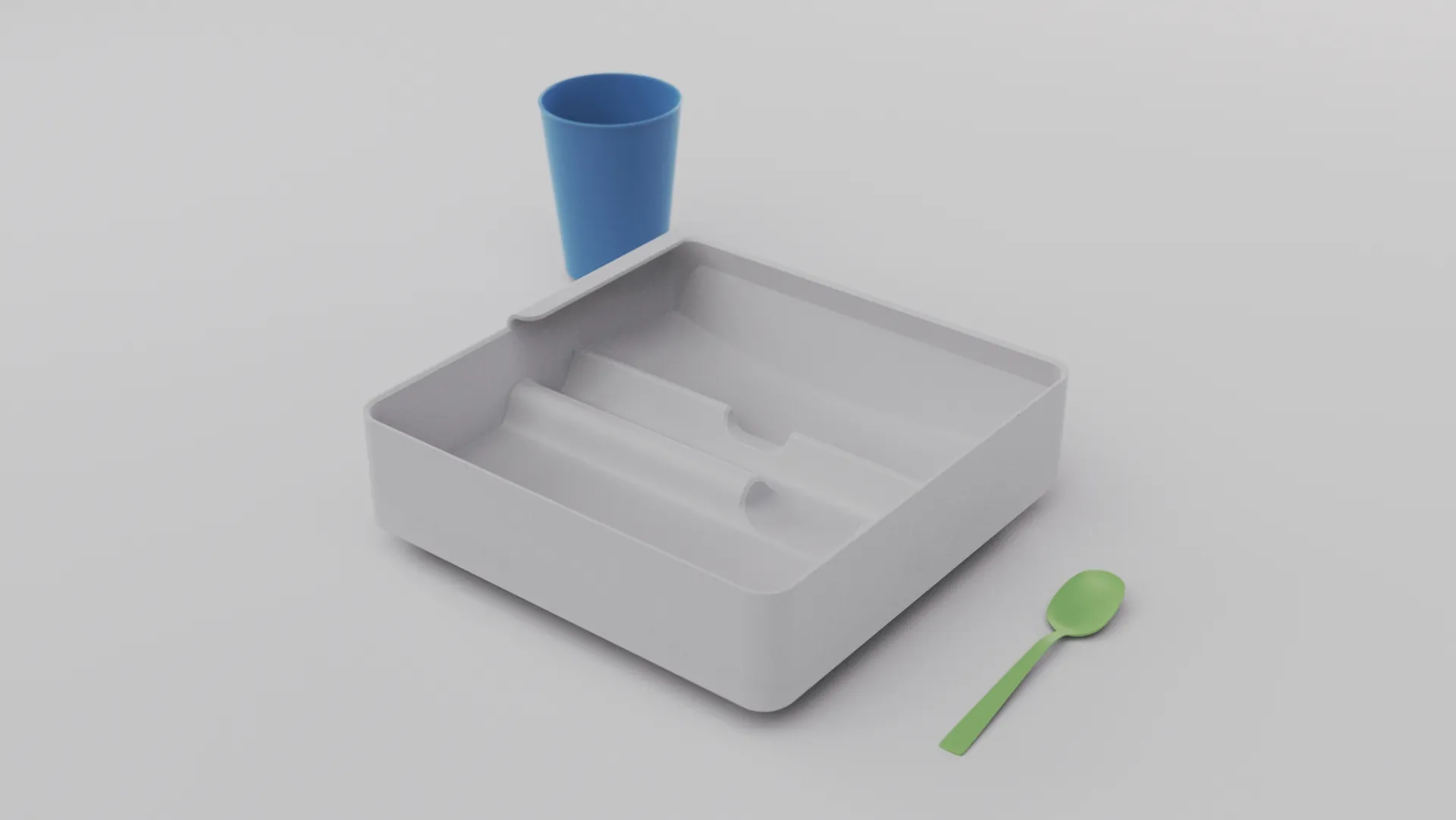
A tray built around an Indian meal, drawing on how much easier patients found it to scoop food from a bowl than to balance it on a spoon. This concept was taken forward as the final product.
04 · Deliver
Final Product
The tray from Concept 2 became the final product. It is built around an Indian meal: a separate compartment for curry or dal, and a buffering area where rice and curry can be mixed before being scooped up.
Guided by Prof. Swati Pal, with feedback from Prof. Ravi Poovaiah and Prof. Venkatesh Rajamanickam on the panel.