
One day of sales
- ₹14.6k
- Gross revenue, stall + pre-orders
- ~67%
- Gross margin (~₹9,867 profit)
- 3.1×
- Revenue on ₹4,744 of spend
- 111
- Stall orders from 96 customers
Low-Key was a two-person venture between Devansh and me: we designed, 3D-printed and sold a line of 14 keychains and collectibles at Felicity, IIIT Hyderabad’s college fest, all in one day of sales. Our cheap impulse items (₹29–₹59) sold out, while the ₹75–₹99 dinosaurs and snakes mostly didn’t, which taught us how to price and stock for next time.
The stall on the day
Printing the Felicity keychains
01 · Understand
Understanding the Students
Fest stalls usually sell food or generic merch. We had a 3D printer and design skills, and we bet that students would pay for small, funny, personal objects if the price felt like an impulse buy.
That bet set three rules for the product: keep the entry price low enough to buy without thinking (from ₹19), include pieces that are simply funny, like the joke Hand, and offer each design in up to eight colours so it felt like the buyer’s own.
Capital
Under ₹6,000
Our total starting capital. I contributed design and production work rather than cash.
Time
About a week
To design, print and finish everything before the fest.
Throughput
One printer + a friend’s
The workshop printer plus help from Kaushal. Every piece took print time, so every design had a real opportunity cost.
02 · Brand
Branding in Their Voice
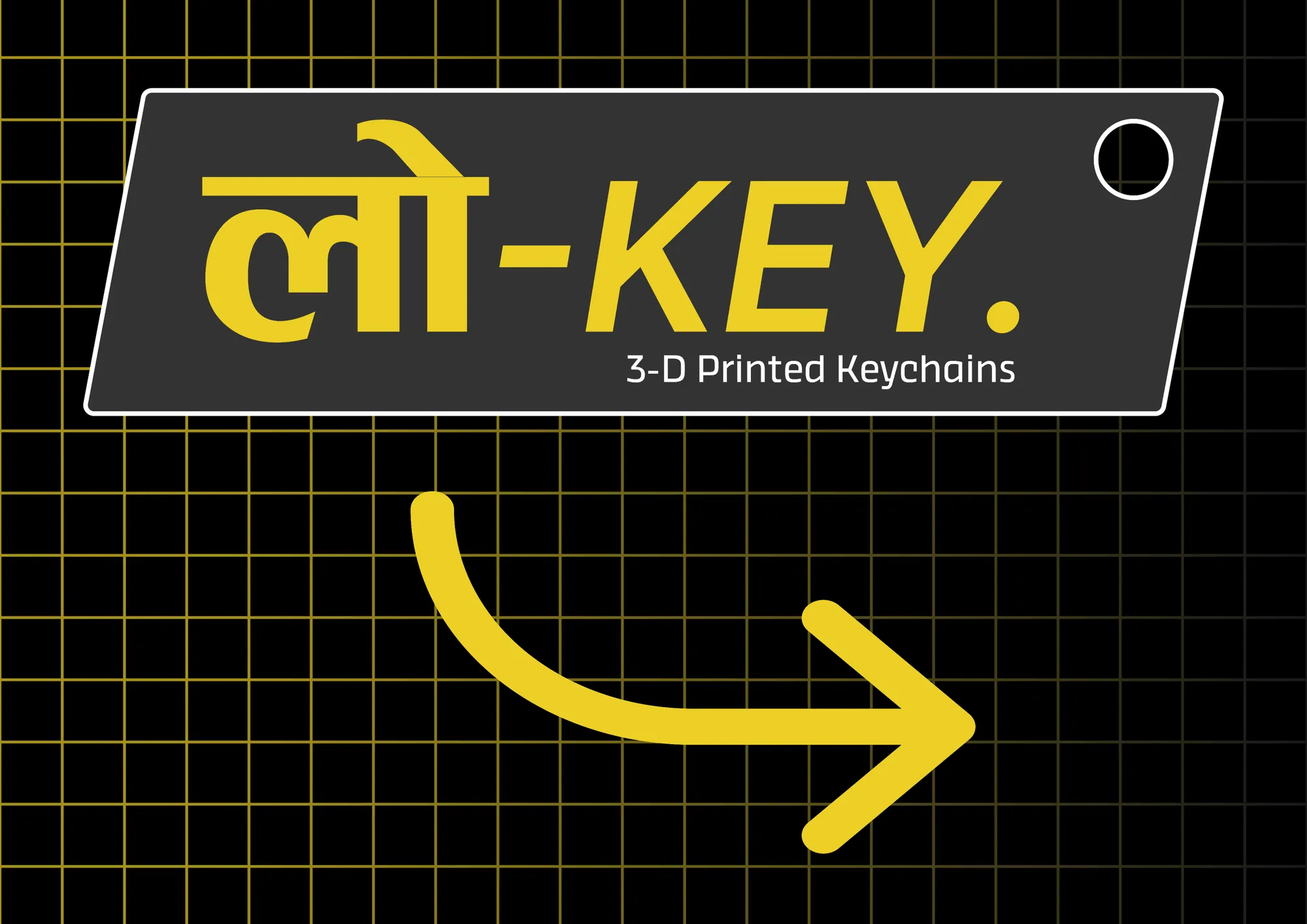
The name is a pun students get at a glance: ‘low-key’, everyday campus slang, written as लो-KEY. लो (lo) is Hindi for ‘here, take it’, and KEY is what we were selling. The logo is itself shaped like a keychain tag, ring hole and all, so the brand and the product look like the same thing.
Speak like students
“Cool keychains, cool prices!!” and “starting @ 19/-”: short, loud and casual, the way students talk to each other.
Lead with the price
On the poster, the ₹19 starting price is the biggest thing after the logo, because price was the whole hook.
High contrast, one colour
Yellow on a black grid reads from across a crowded fest ground and carries through the logo, the poster and the order messages.
The brand is a product
The Low-Key and Low-Dey keychains carried the name, and doubled as cheap add-ons that grew the basket.
03 · Build
Building the Stock
We built a 14-design catalogue in price tiers, from impulse buys to one showpiece, and also cleared Devansh’s older Minecraft and Pokémon prints at ₹99 each.
Impulse
₹19–₹29
Low-Key, Low-Dey and Felicity keychains.
Core
₹49–₹59
Heart, Rose and Hand (the joke one).
Collectible
₹75
Shark, T-Rex, Saurus, Smooth Dragon and Spiky Dragon.
Premium
₹99
Snake and Skeleton.
Hero piece
₹600
The Big Dragon.
Each design came in up to eight filament colours: olive green, baby pink, lavender, white, yellow, light blue, black and red. We set a target of 311 units, worth ₹19,628 at list price, and tracked stock against it for every design and colour. When pink and purple ran short, we scheduled targeted print runs to fill the gaps.
Production was split between the college workshop and Kaushal’s printer, batched by colour so we changed filament less often. One batch of about 65 pieces used roughly 700 g of filament.
04 · Sell
Marketing Before Opening Day
We designed the logo and the poster in-house before the fest. The poster answers every question a passing student has in one look: what (cool keychains, cool prices), when and where (11 AM–6 PM, 13 February, at the Football Ground) and the hook, starting at ₹19.
04 · Sell
Setting Up the Stall
We laid the stall out to minimise movement on both sides of the table. Products sat in open boxes along a single table, grouped by design and labelled with their prices, so a buyer could see, compare and pick from one spot. The poster hung from the front of the table to pull people in, and payment ran through a QR code at the stall, so an order went from picked to paid without anyone walking around.
The team at the stall, poster on the table front
Designs grouped in open boxes along one table
Every order was logged in a shared sheet by customer name, amount and product number. That log is the dataset behind the numbers on this page.
04 · Sell
Selling on the Day
Impulse pricing drove volume. The most-bought items were all ₹29–₹59, and the most common order was a two-item ₹69 combo of Low-Dey and Hand. It came up so often that it was effectively a bundle we never designed on purpose.
- Hand
- ~27
- Heart
- ~24
- Felicity
- ~23
- Rose
- ~22
- Low-Dey
- ~18
Estimated from order codes in a hand-entered log; may be off by a few units.
Bundles raised order value. The median order was ₹69 but the average was ₹95, pulled up by a few large orders (₹739, ₹454, ₹385, ₹367), mostly people buying several Hearts and Roses as gifts. The largest single order was 11 items.
05 · Follow up
Follow-up Orders
The stall kept selling after it closed. We took custom requests for specific colours and characters over WhatsApp, with UPI payment, then printed and delivered them after the fest, letting each buyer know with a branded “Your Order is Ready!” message. Pre-orders added ₹3,398 on top of the stall’s takings, and every one of them was personalised.
06 · Learn
What the Data Showed
The collectibles were overproduced. They were the longest prints and the highest prices, so they tied up the most printer time and money for the least return. Overall, about 96 of roughly 298 units were left over, a ~68% sell-through.
- Saurus
- 15
- Snake
- 11
- Smooth Dragon
- 9
- Shark
- 6
- T-Rex
- 6
- Spiky Dragon
- 6
Nostalgia sold well: 11 of the 14 Minecraft pieces from Devansh’s old prints sold at ₹99 each, a better sell-through than our own ₹75 dinosaurs.
- Filament
- ₹3,100 · 65%
- Keychain rings & hardware
- ₹1,070 · 23%
- Porter / transport
- ₹394 · 8%
- Poster printing
- ₹180 · 4%
We broke even at about ₹4,750 in sales, less than half of what the stall took in its one day. Everything after that, including every pre-order, was profit.
06 · Learn
What I’d Do Differently
- Cut the collectible tier in half, and use the freed printer time for Hearts, Roses and Hands, which sold out.
- Make the ₹69 combo official, and add a ₹99 three-item bundle to move people up from the median order.
- Lead with custom colours: every pre-order was a personalised request, so people will pay for “my colour, my character”.
- Use the ~96 leftover units as starting stock, so the next stall opens with inventory already paid for.
- Add printers before adding products: printer time limited us more than demand did.