



Evaluated on six meetings
- 124
- Candidate sentences flagged across 6 meetings
- 73
- Tasks extracted from 89 detected decisions
- 0.753
- Average confidence of the hybrid detector
- 4
- Transformer models in the pipeline
01 · Problem
The Execution Gap
Meetings happen; commitments disappear. Decisions are made out loud and assigned verbally, and then they leak: follow-ups are missed, ownership is unclear (everyone’s task is no one’s task), nobody can trace a task back to the conversation it came from, and coordinating all of it becomes work in itself.
Teams don’t fail at deciding. They fail at following through.
Recurring meetings, recurring gaps
Sprint planning, stand-ups and reviews happen every week, and so does the same problem.
Scale makes it worse
More people and more roles mean more chances for a commitment to fall through the cracks.
Note-taking isn’t the answer
It’s slow and error-prone, and still disconnects tasks from who said what, and when.
The cost isn’t one missed task. It’s the compounding effect of every missed task, every sprint.
02 · Research
What Exists Today
Research on meeting corpora like AMI and ICSI shows that detecting action items in multi-speaker dialogue is genuinely hard. Earlier approaches used rule-based cue phrases, supervised utterance classifiers and sequence models, and all of them hit the same tension: over-detect and users stop trusting the system; under-detect and commitments are missed.
| Tool | Strength | Gap |
|---|---|---|
| Otter.ai | Transcription and notes | No structured action-item workflow |
| Fireflies.ai | AI summaries | No evidence-linked task publishing |
| Fellow.app | Meeting follow-ups | Relies on manual input |
| Notion AI | Notes to tasks | Not meeting-native |
| Asana / Jira / Linear | Strong task management | Task creation isn’t driven by transcripts |
No existing tool combined all four: transcript-native extraction, evidence-linked interpretability, human review before the backlog, and a usable project workflow.
So the system had to:
- Extract reliable action items from English meeting transcripts.
- Link every task to its speaker, quote and timestamp.
- Organise tasks in a team-aware Kanban board.
- Let a human review every suggestion before it reaches the board.
- Generate per-meeting summaries of decisions and action items.
- Support filters, personal task views, subtasks and history.
03 · Product
Introducing Makezy
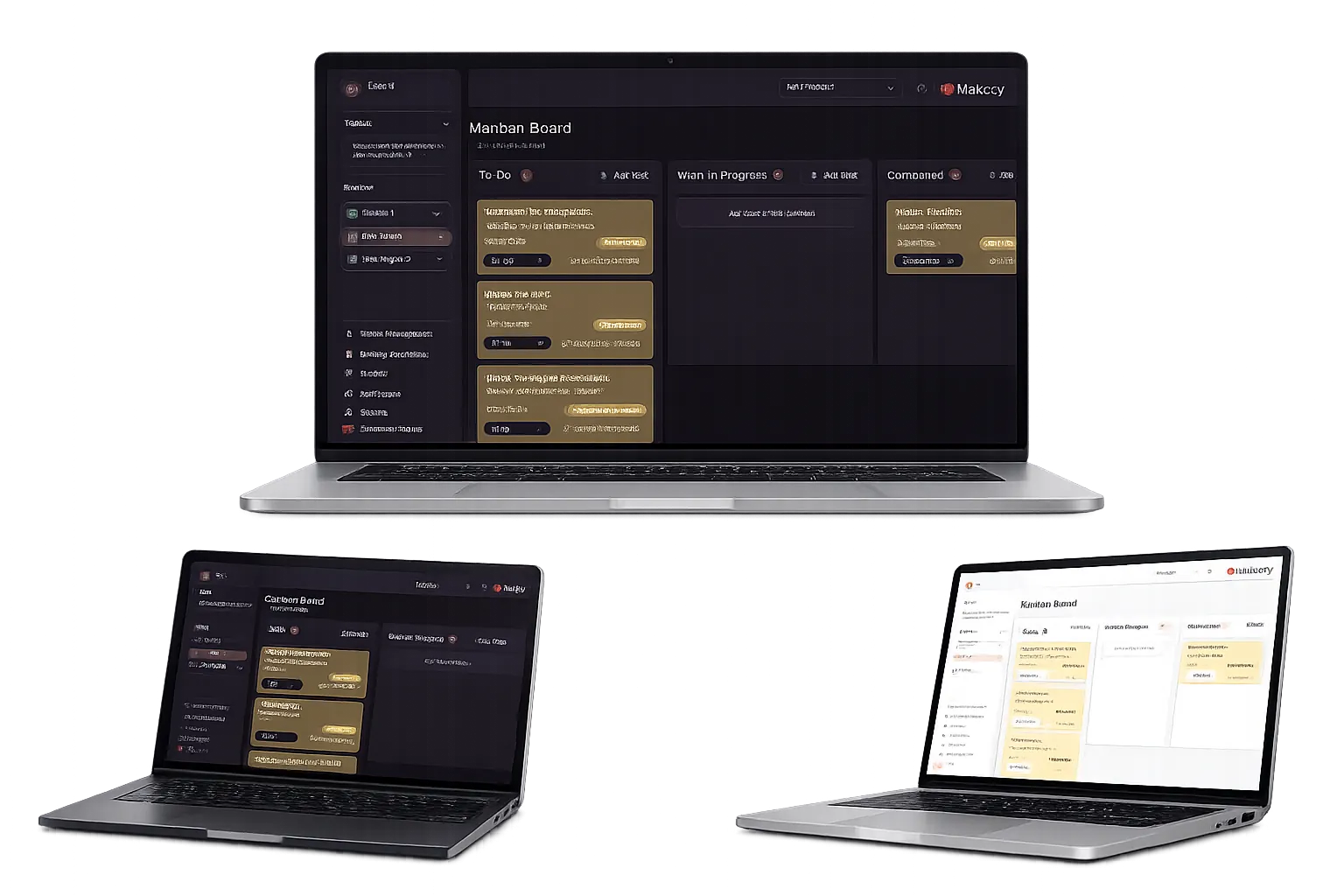
Makezy auto-detects every commitment, decision and action item in a transcript, puts each one in front of a person for review, and publishes the approved tasks straight to a Kanban board with an assignee and a deadline. It isn’t just an NLP model; it’s a full product.
| Step | What happens |
|---|---|
| 1 · Upload | Drop in a meeting transcript |
| 2 · Clean & parse | Speakers, sentences and references are resolved |
| 3 · Decisions | The pipeline flags sentences that carry a commitment |
| 4 · Tasks | Each decision becomes a task with assignee and deadline |
| 5 · Edit | A person reviews, corrects or rejects every suggestion |
| 6 · Publish | Approved tasks land on the team’s Kanban board |
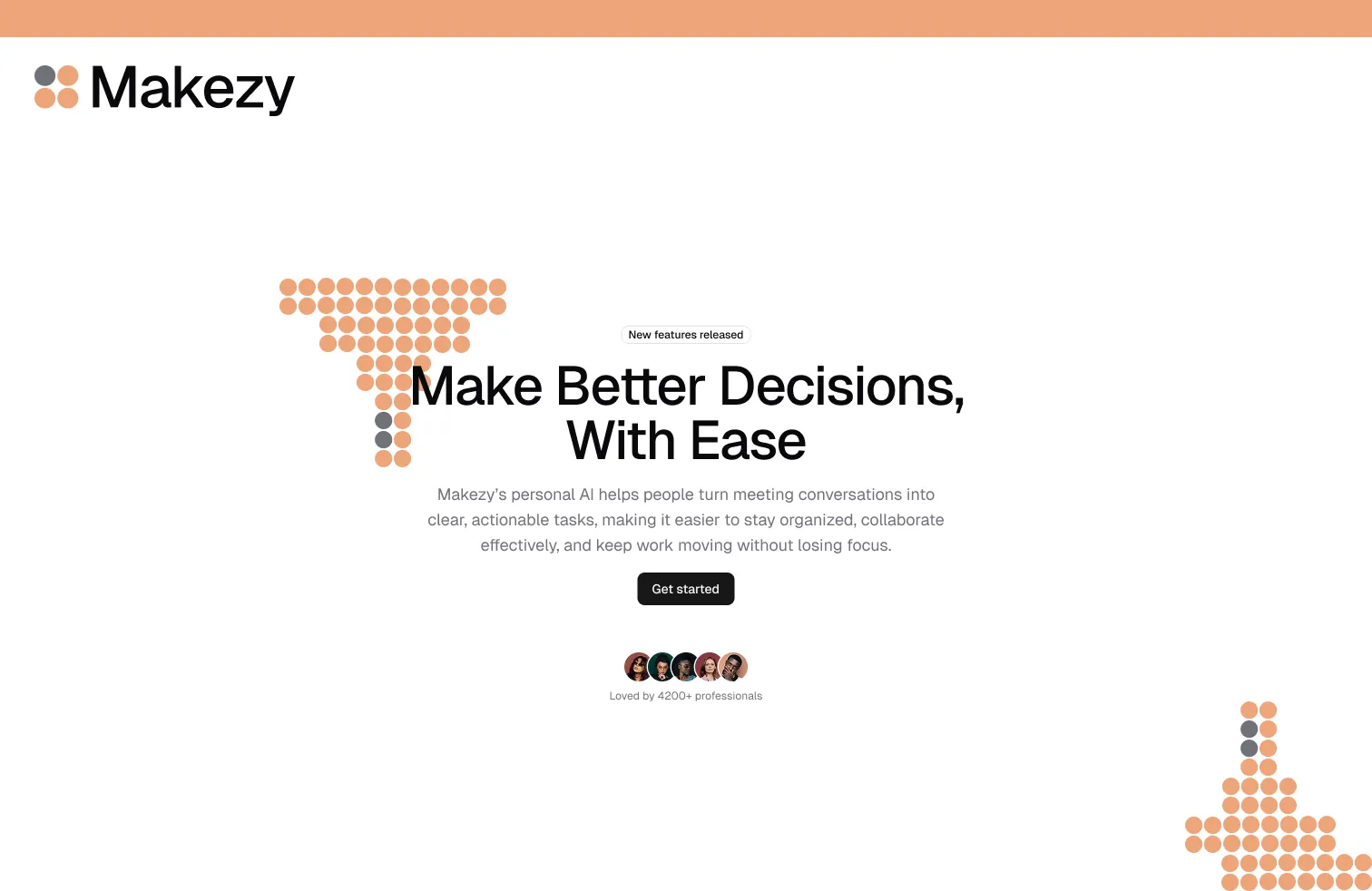
The Makezy landing page
Processing a transcript
Linked to the source
Every task points to the exact transcript sentence it came from.
Attributed to a speaker
You know who made the commitment, not just that it exists.
Human approved
Nothing reaches the board until someone has reviewed it.
Those three trust pillars are the heart of the product. The task board doesn’t just tell you what to do; it shows you why.
04 · Engineering
Inside the NLP Pipeline
Behind the product is a four-stage pipeline that turns a raw transcript into structured tasks:
1 · Preprocessing
spaCy
Parses speakers, splits sentences, cleans text and extracts subject-verb-object triplets, resolving pronouns so “she’ll do it” knows who “she” is.
2 · Decision detection
Rules + zero-shot NLI
A hybrid of keyword rules and a transformer classifier (cross-encoder/nli-distilroberta-base) scores each sentence; only confident decisions pass.
3 · Metadata extraction
QA + NER
A question-answering model (roberta-base-squad2) and named-entity recognition find the assignee; temporal parsing finds the deadline.
4 · Postprocessing
FLAN-T5 + embeddings
FLAN-T5 writes a clean task description, scores are fused into a confidence, and sentence embeddings (all-mpnet-base-v2) remove duplicates.
The full system is a React frontend for uploading, reviewing and managing tasks, a Python backend for APIs, authentication and pipeline orchestration, the NLP module above, and MongoDB for meetings, transcripts, suggestions and teams.
05 · Results
Evaluation & What We Learned
Across six meetings, the pipeline flagged 124 candidate sentences, detected 89 decisions and extracted 73 tasks, with an average confidence of 0.753. On a sprint-planning meeting it worked cleanly: “I will handle the API deployment to staging by end of Friday” became a task with a named assignee, a deadline and 0.89 confidence.
Business meetings were harder. In an early evaluation on a quarterly review, the system found every real action (100% recall) but only 30.8% of what it flagged was actually an action: status updates like “Revenue is up 12%” and reactions like “That’s concerning” looked like commitments to the model. We added filters for metric sentences, short reactions and paraphrased duplicates, so those are now rejected.
| Case | Example | What happens |
|---|---|---|
| Implicit assignment | “The DevOps team should look at this” | Missed: no named person to assign |
| Passive voice | “The documentation needs updating” | Missed: no agent detected |
| Metric sentence | “Conversion rate went from 15% to 22%” | Rejected by the metric filter |
| Reaction | “Sounds good”, “Agreed” | Rejected: low confidence, short length |
| Duplicate | The same task, paraphrased | Merged by the deduplicator |
Only 31.1% of extracted tasks had all three fields (task, assignee and deadline) filled. That isn’t only a model problem: people rarely say both who and when out loud, which is exactly why the human review step exists.
Next, we plan to add:
- Real-time speech-to-text action item generation
- A calendar view and even shorter task representations
- Multilingual support
- A team-level analytics dashboard
- Aggregating tasks that span several sentences
05 · Results
My Take
The most important product decision in Makezy wasn’t a model choice; it was putting a human between the model and the board. With 31% field completeness and real false positives, an auto-publishing system would have filled boards with noise and lost the team’s trust within a week. Review-first turns an imperfect model into a useful product.
The evaluation also taught me that precision matters more than recall for a tool like this. Missing a task is annoying, but a board full of wrong tasks makes people stop using it, so it was worth trading a little recall for trust. And every task linking back to its quote and speaker is what makes reviewing fast: you can see why the system suggested it in one glance.
05 · Results